
Day 23: Why We Can’t Ignore Logic

So, in the world of argumentation, the pendulum has swung pretty hard to the pathos side of things. Pathos is just a fancy word for emotional appeals, of course. It means that we focus on feelings and use words that mostly equate to sensitivity and getting people to connect on an emotional level.

The other side of the pendulum, though, is logic. Logic isn’t pretty. It’s more like the awkward cousin the cool girl has to bring to the party because her mom says she has to go too. Logic is edgy. It doesn’t feel much of anything. But it knows a lot, and it won’t shut up about numbers and evidence and proving you know what you’re talking about.
http://beggars-opera.tumblr.com/post/153358479007/so-i-just-found-the-most-useful-photo-album-in


But, in the world of argumentation, we need them both. Pathos and logic. They work together. The best arguments have both, but these days, we have a tendency to push logic off toward the walls while we splash some flashy colors and fancy lights on the dance floor, play a well-made video, and call a viral hashtag an argumentative success.

But logic, as plain and boring as it can be, is important. And we ignore it to our great loss.

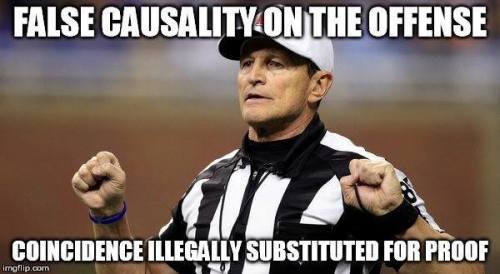
This is most apparent when we try to show cause. Arguing cause is a big deal. To show that something caused something else is the basis for every legal case we make. Before someone can be punished for a crime, we have to be able to prove they actually DID the crime. They caused the harm. It was their fault.

Showing cause requires that you can prove certain connections between two events. Specifically, to demonstrate cause you have to be able to show that the first thing happened (the woman wore that dress) and it led directly to the second event (he raped her) with no intervening influences. THIS is the important part.

If there is anything that can intervene in the situation (as there clearly is in the “dress to rape” argument), you are not dealing with cause. PERIOD.

When we talk about sexual harassment or assault, there is always an intervening event. The path between her wearing the dress (or going to the party or whatever) and any sexual harassment or assault is littered with intervening events: namely, his choices. Her dress might cause his initial, involuntary physical reaction. But after that, he begins to make choices: to look again (and again), to desire her, to claim her in his mind as something he deserves, to objectify her, to touch her, to speak to her, to force himself on her.

All of those choices are his alone. And that precludes any possible causal link between her dress or party choices and his behavior. In other words, no woman ever causes her own harassment.

And yet, people often confuse causation (showing cause) with another logical connection between ideas: correlation. Correlation means that two (or more) things are related and impact each other. There is influence between or among them, but what that exact influence isn’t clear. Any other piece of information (what clothes she wore, that she attended the party, that he spent a lot of money buying drinks for her) falls squarely in the correlation side of things. They may be interesting details, but they have nothing to do with the direct cause. And they are almost entirely fueled by the pathos side of the argument: focusing on how someone felt (or feels now) and not the actual events as they happened.

Pathos is necessary, but it can complicate or confuse our arguments far too easily. The ability to argue cause well (or to hear when it’s being confused with correlation) will help us make better arguments and respond more effectively to the arguments we hear.

What do you think?

Do you prefer pathos or logic? What arguments have you heard that confused cause and correlation? Do you think including logic with pathos helps or hinders our communication?

 

Day 21: Why #notallmen Is Important

I saw an article yesterday that said #notallmen is not relevant because all women are at risk of sexual harassment or assault or worse. And it bugged me. But I wasn’t sure why for a while. But as I thought about it, here’s what I came up with.

1. All women are at risk. It’s really unlikely that a woman has never been catcalled or touched inappropriately or had a conversation with a guy that suddenly turned all weird. Maybe she hasn’t experienced all of those, but at least one. I’m willing to bet money on it. BUT this fact, that every woman–including me and my daughters–has to deal with this issue, doesn’t negate the importance of #notallmen.

The truth is, not all men do these things. They don’t let themselves get swept up in desiring or mentally undressing a woman. They don’t say the sexual thing that pops into their heads. They don’t touch or manipulate or overpower a woman (conscious or not). Some do. But most men don’t.

And we have to recognize and give appropriate respect to these men. We can.not sweep them under the rug or, worse, into a group of “all men are rapists…some just haven’t acted it out yet.” Here’s why…

2. We need these men. We need them. We cannot fight this battle entirely on our own. We need the men who will stand with us. We may even need them to come to our rescue. We need their help and their support.

Of course, there are parts of the battle that women must fight. We have to report the instances when they happen. We have to talk about it with our sons and make sure the issue remains part of the cultural conversation. We have to do the hard work of shame recovery. We have to fight for ourselves.

But we also have to invite these #notallmen to join with us. We have to humble ourselves and ask for their help. And then, we have to do the hard work to empower them and equip them to respond correctly and helpfully. They need us to invite them in. They need us to give them clear directions: how to speak up, what to do, who to call, how to comfort or help someone who’s been assaulted. They won’t know this on their own; we have to tell them.

And I get it. No one really wants to do this. It’s hard. It’s easier to dismiss all men out of hand. It’s easier to say they should just know all this stuff and we shouldn’t have to teach them. It’s so obvious to us, after all.

But if we do that, we’ll be wrong. First of all, it isn’t obvious to us. A woman who’s been degraded, physically or verbally, doesn’t always know how to respond or who to tell. When the online chat suddenly turns sexual, we don’t immediately know what went wrong or how best to handle it. We don’t know, and the shock of it (and the shame that follows it) keeps us from doing anything at all sometimes. So we can’t blame the #notallmen if they don’t know right away either.

Second, dismissing all men out of hand, grouping all men with Weinstein and others like him, will result in a gender version of what’s been called the Ferguson effect. Because police risk being called racist, they are less likely to check on suspicious behavior which means more crime is being done and more people are being killed. Whether you agree with this concept in racial terms or not, it’s entirely plausible that a similar effect will happen in the #metoo conversation. Men would might have fought with us will be disempowered and discouraged, and they will simply walk away, leaving us more at risk than we were before.

Third, demanding that they “figure out” what we need from them puts them in an incredibly frustrated position. “Help,” they’ll hear. “But not too much. And not in the wrong way. And never in the wrong place or time. And you should just know what all of that means and apply it correctly all the time.”

It’s too much. We have to educate. We have to have hard conversations with the men in our lives, especially our sons. It feels humiliating, but we have to keep saying it until they understand. Until they really get it. And when they get it, they’ll be empowered to act. They’ll know they can ask if they are unsure. And they’ll have the basic skills and information they need to work with us.

The ultimate goal of #metoo cannot be just to air our dirty laundry. The ultimate goal can’t be just the destruction of lives and reputation. The ultimate goal has to be redemption, healing, and restoration. To unify and empower all of us, men and women, so that we can protect the weak, give boundaries to the powerful, and heal those who have been damaged by the selfishness of others.

But to make that a reality, we need #notallmen. And we need them on our side.

Day 19: Why We Give Back

I don’t really care where or how you give back. I really don’t. But I am firmly convinced that we all need to do it. It makes unimaginable differences for us to get out of our own heads and share something with another person…both for them and for us.

And we all know that, really. But here’s the thing.

I’ve noticed this huge assumption in our culture right now that we are supposed to fix all.the.things for all.the.people right.this.very.second. And if we can’t, you know, undo all racism and all sexual abuse and all poverty and all child hunger (and on and on), then we shouldn’t even try. Or if someone does try, they get mocked because it isn’t big enough or flashy enough to fix all.the.things. The gesture seems so small in the face of the huge mess we make of things that we punish them for daring to call their effort valuable.

Can I please encourage you to find and eliminate that kind of thinking? Please? If you have been avoiding doing that one thing you can do because it can’t fix all.the.things–that’s okay. Do it anyway. If you’ve been harping on people whose honest attempts to do one small things didn’t seem sincere or grandiose enough–could you consider giving them the benefit of the doubt?

It does take a lot of time and energy to give back well. It can come across and condescending or smarmy, like when we give money or time but don’t stop to see the person who’s in need of it. Or it can be utterly useless and self-serving, like sending sweaters and broken junk to a donation drive for hurricane relief.

But it can be done well. And we need to keep trying and learning and doing it so that we can learn to do it well. I tell my kids, “How do you get better at doing something? You practice!” And the same holds true for me and giving.

So what can you do?

Well, our PTO stumbled on a neat way to help out another school that was devastated by the hurricanes right before the start of school. We did a fundraiser with our kids. Then we discovered that we can use that money to purchase books online for their school’s Scholastic Book Fair. They can tell us which books they can use, and we can order them as a donation which Scholastic will then ship straight to their school for free. AND the money we spend counts toward their profit which determines the Scholastic Bucks they earn through their Book Fair (which they can use to get even more books), so in effect, the money our kids raised does double-duty in helping this school replace the books it lost (ALL of them, people…they lost ALL of them).

This route took a bit of research. And chats with our librarian. And a phone call to our Book Fair rep. But (I think) we are actually going to be able to give back in a tangible way. Our “help” is actually going to be useful to them. We can meet an actual need.

We don’t have to solve ALL the problems of EVERY school that was devastated by a hurricane this fall. We don’t even have to solve all of the problems of THIS one school (they’re still in temporary buildings, they still don’t have pencils or paper or anything). BUT we can do this one thing and do it well.

And so can you. Look for the one thing that you can do, for someone or a group of someones who needs what you can offer. And then do another. And another. And if we all make that our pattern, I think we’ll make a bigger difference than we can ever imagine.

Just Stop Right There

So I typically behave as if pain is to be avoided at all costs. You know, get comfortable, stay comfortable. Repeat. And for pretty much all my life, anything that interrupted this cycle was bad. Capital BAD.

But I’m finding, surprisingly, that it’s really not. The last year (and more) has been an interesting study in trying to open up doors instead of slamming them shut. Like the day I thought “Maybe [that experience] wasn’t about me, as much as it was about them.” The day I wondered if, just possibly, I wasn’t the broken one.

I’ve read (and cannot recommend highly enough) Brene Brown’s books. Her dream was to start a national dialogue on shame and whole-heartedness. And y’all. Those books hit me right where I hurt. Really hurt. Pain I hadn’t realized I was carrying around. Burdens I thought made me unloveable. Experiences that had left me thinking, truly believing, that there was something just wrong with me.

It was shame. All of it. And cracking open the door onto those places in my heart was both excruciating and freeing. And all of that is a fun story for another day. But as a result of all of that, I’m learning to pay attention to pain in an entirely new way.

Pain is not something we’re supposed to sit on, hide, cover up with make-up and the latest fashions, or brush off like we’re all good. When we run up against pain, we’re supposed to STOP. Our pain is there to tell us something. Something important about who we are and what we need to deal with. But we often don’t recognize it as pain. It shows up in disguises that we have to begin to recognize so that we can begin to move past them in positive ways. I can think of two, in particular…

Stop #1: Defensiveness.

Defensiveness is that panic that grips your heart when someone challenges you, your lifestyle, your choices in music or movies, or whatever else you hold dear. A comment is made, and your first response is to clamp down and DEFEND yourself. Get out the big guns and blow away anything that seems to threaten that whatever you’re sure you need to survive.

Can I suggest, please, that defensiveness is really a pain-marker? It’s not a declaration of war; it’s a warning signal. A sign that something deep and real, inside your heart, feels at risk. It signals pain. So the next time you feel defensiveness rise up in your heart and your breathing starts to get hard and you start to type that pushy, unkind comment on social media. STOP. Just stop. Take 3 big breaths. And ask yourself: “Why is this so important to me? What am I really afraid of losing? Is it this? Or is it something bigger? And will fighting with this person really protect what feels threatened?”

My guess is that it’s something bigger. Mine usually is. Defensiveness is often just fear, wrapped up in anger, that my life, my personhood isn’t really important. And my response is, too often, to shut down the person whom I feel is threatening me. Except that doesn’t really help. Defensiveness shuts down. It feels like protection, maybe, but it’s really not. And the only real way to ensure the protection of what’s important to me is to open up, not shut down.

Stop #2: Contempt

This is a huge issue for me. My internal monologue is filled with contempt, unkind thoughts and judgments about everyone and everything around me. But contempt, too, is a marker. It’s not really about whomever I’m holding in contempt. It’s really about me.

And the only way to deal with this issue is to accept that my contempt is an attempt to mask my own pain and fear by blaming and degrading and dehumanizing someone else.

So I have to STOP. I have to catch myself. I have to challenge my contemptuous thoughts with ones that say “He is a person and he matters” or “She is valuable” and “She matters to God.” Even though they still disagree with me. Even thought they’ve been unkind. Even though they are filled with contempt for me. I have to STOP. And when I do that, I find that, instead of spewing out on them a waterfall of contempt, I open up to the fact that maybe they might be hurting themselves. Maybe they just need me to hold their story, their pain instead of adding to it. And maybe I can be patient with them for one more day.

The only way we are going to stem the flood of hatred going on right now. The only way that I can think of to help heal the hurt I see and feel in the posts my friends are sharing. The only way we can be part of the solution…is to STOP.

Pause. Call your responses by their true name. Defensiveness, not patriotism. Contempt, not justice. Bring them out in the open and make them answer for themselves. Our responses say much more about our own pain than about anything else.

Let’s find ways to open our doors, our hearts, our minds, our lives. Share our pain and our stories. Be part of the path forward. I believe this is what Jesus does for us. And I believe this is what He calls us to do for others. Together, we can stop right here.

Black and White

I wish the world was black and white. I really love absolutes. They make things so much simpler, you know?

But over my (not quite) 40 years, I’ve repeatedly banged up against the reality that life is, in fact, not black and white. Problems are complex and require complicated, multi-faceted solutions. People are complex and need to be seen and respected as whole persons, more than merely one idea or one diagnosis or one caricature. Ideas that seem simple turn out to be deeply layered with connections to a thousand other ideas, all of which need to be acknowledged. Very, very little is actually black and white.

As much as we want to reduce our family, today’s events, or deep theological ideas down to “what I want them to mean or be,” we can’t. The world is bigger than we understand. People have to be allowed to be whole, even when we don’t understand them or don’t agree with them. Ideas cannot be boiled down to one side (or the other) and call it good.

Someone argued a week ago that any musician who played for the inauguration was complicit in EVERY action, idea or effect that Mr. Trump has had or done or ever would have or do. And it’s simply not true. I am not complicit in the behavior and beliefs of every single person I ever choose to be seen with in public or work for in a job or choose not to openly disagree with. Neither are you.

I may have to stop hanging out with someone or quit a certain job because of someone else’s stance. I may have to separate myself sometimes. But we should also be able to be be seen with someone without being accused of automatically agreeing with them on every single point. It is possible to sit in a church and not agree with every single point of doctrine as that denomination or the person in the pew next to me. Even worse, the word complicit indicates a deceptive, conniving duplicity that we must be VERY careful about applying to others, especially an “other” who disagrees with you.

Or then there was the article I read about how the liberals are all running crazy, trying to keep up with Mr. Trump’s pace. Which I followed with an article about how the right was on the defensive and all the protests were working. Exactly the same events, two completely different narratives. No blending, no trying to see the other side. Everything filtered into a single “This fits the way I want to see it” narrative.

Then there’s the #deleteuber tag that started flying after the Uber drivers did not join the taxi drivers’ hour-long strike at JFK over President Trump’s refugee order. The outrage was everywhere. People were deleting Uber, declaring they would only ever use Lyft. And on and on. And then this morning, I read that supporting Lyft might mean you are actually supporting Trump (indirectly) because one of the financial supporters of Lyft is also a Trump supporter. The black and white protest turned out to have, potentially, the opposite effect that was intended.

And that’s just it. People, ideas, decisions are connected in such deep, and often unseen ways, that we cannot trace every result, no matter how much we want to. And while we should all be careful to examine the ideas and people and solutions that we choose to be party to, there are indirect consequences to every word and idea and decision. And black-and-white demands those be controlled, too.

The Black-And-Whiters on both sides demand the world match their perspective of it. Their way is right. Any other way is snubbed. Their logic makes perfect sense; others’ words are twisted. Their values matter; anyone else’s values are laughable.

In this perspective, I am responsible to make everyone happy. And if I don’t make someone happy, they might get me fired, or make sure I never work again, or #delete me. If someone disagrees with me, or I don’t toe some line on every.single.point, then I am, by a Black-And-White mentality, barely human and certainly not a Christian.

But the world is NOT black and white. It hasn’t been for a very long time. And I have spent my life trying to UN-learn the perfectionistic, control-freak tendencies that tell me that if I don’t control every single thing I do, every outcome of every thing I do, and every person’s reaction to every thing I do, then I am a failure. I am not. Neither are you.

Even worse, if we can’t get a grip, we are going to crack. People are having near-conniption fits on Facebook. We are living in a land where the “slippery slope” is the regular battle cry. (i.e., “OMG! If ______ happens today, we are GOING to have (fill-in-the-blank) before the end of the week!!!) This isn’t healthy or productive.

We have to back it down. We need rational, coherent, effective dialogue. Because Black and White is not how the world works the vast majority of the time, and that’s okay. But the rhetoric, the battle cries, the personal attacks, the social media blackmail. Those are NOT okay. Ever.

We need to calm down and talk to each other. Speak kindly to everyone, no matter where they stand on an issue. Heavens, maybe we’ll find we agree with each other more than we think we do. And even when we must stand apart, defending something we value, we can remember that the world is not black and white. And it doesn’t have to be.

In fact, by putting all the ideas on the table and letting our differences HELP us, we can actually come out of this crazy time with greater unity, better solutions, and more people engaged and sitting at the table. Instead of black-and-white, we rediscover the proverbial melting pot. And we might actually find it a really great place to be.